Express delivery and free returns within 24 hours

No.2-1, Fourth Road, Yongkang City, Jinhua, Zhejiang Province

info@biyoti.com

home/news

News

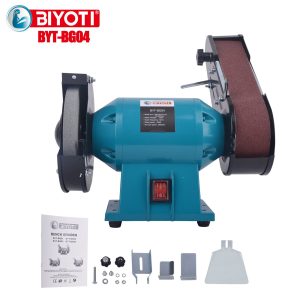
What Are the Functions of a Bench Grinder

What Are the Functions of a Bench Grinder?

A simple setup for a bench grinder includes a motor, a wheel, a work rest and a base that is fixed in place. What one may see as a simple unit for cutting metal can in fact perform many other functions when using the right grinder. The bench grinder is able to sharpen worn tool edges, remove rust from work parts, file smooth cut ends, cut and shape smaller work pieces, prepare work surfaces prior to assembly, and even perform typical tool maintenance. Bench grinders for workshop sharpening are compared by potential buyers not only for their use, but also with regard to the actual space required in the workshop. A machine that can be used for daily sharpening, rough grinding, fine sanding as well as for polishing is needed. Such a machine is the BYT-BG04 BENCH GRINDER, a compact, 2-position bench grinder. What Is the Main Purpose of a Bench Grinder? The bench grinder is a tool used to remove material in a controlled manner. It is a high-speed abrasive surface which can be used to cut, grind, to clean or to even out a workpiece surface. In small workshops, repair benches, in garages and also in DIY workshops the
Read More
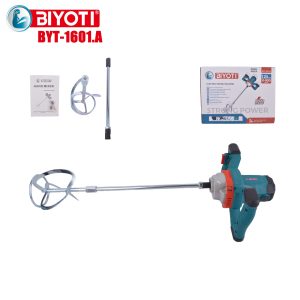
Electric Mixer Applications Beyond Construction

Electric Mixer Applications Beyond Construction

Electric mixer applications are no longer limited to cement, mortar, and jobsite buckets. In many small workshops, coating rooms, repair teams, farms, and DIY production spaces, a handheld electric mixer has become a practical tool for mixing paint, putty, glue, resin, feed, fertilizer, and other medium-to-thick materials. The reason is simple. Many materials fail before they are applied. Paint separates in the pail. Putty powder forms dry pockets. Tile adhesive gets heavy at the bottom. Feed additives may not spread evenly through the batch. A steady electric mixer for paint and mortar can reduce these problems with controlled speed, stronger torque, and better paddle movement than manual stirring. The BYT-1601.A ELECTRIC MIXER is built for this type of work. With a 1200W pure copper motor, 220V~50Hz power supply, 0–900r/min stepless speed control, dual-handle grip, and 120mm spiral mixing rod, it fits a wide range of coating, construction, chemical, DIY, feed, and fertilizer mixing jobs. Why Are Electric Mixer Applications Moving Beyond Construction? Construction remains the most common market for electric mixers. Contractors use them for cement mortar, tile adhesive, grout, waterproof coating, plaster, and wall putty. But the same mixing problems also appear in other industries: uneven solids, heavy bottom sediment,

Read More
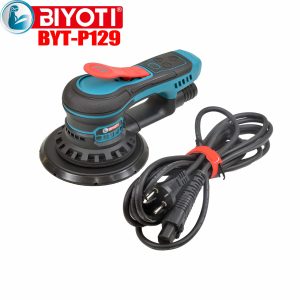
Polisher Maintenance Guide for Longer Tool Life

Polisher Maintenance Guide for Longer Tool Life

A good polisher is not brought to its knees in one dramatic fall from grace. Rather, most problems with polishers are of a gradual nature, i.e. the dust from the polish packs into the vents of the polisher, the polishing pad loses its grip on the surface being polished, the operator applies increasingly greater amounts of pressure with his arm, and the motor of the polisher begins to run hotter and hotter until it fails. These little habits of the operator can cause a polisher to go from a smooth running, long lasting tool to a noisy, weak, and difficult to control piece of equipment. This polisher maintenance guide focuses on three parts that matter most in daily work: the motor, the drive or gear assembly, and the pad system. It also uses the BIYOTI BYT-P129 Polisher as a practical example because its 400W motor, 150mm pad size, 4000–10000 RPM speed range, 5.0mm orbit stroke, and dust extraction design fit many real sanding and polishing jobs. Why Does Polisher Maintenance Matter? A polisher handles heat, dust, pressure, vibration, and long working hours. During automotive body repair, old paint and filler dust can fill the air quickly. During wood sanding, fine particles

Read More
Electric Grooving Machine for Cleaner Wall Channels

Electric Grooving Machine for Cleaner Wall Channels

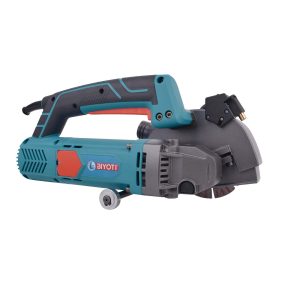
Clean wall channels are not just about appearance. In electrical, plumbing, and renovation work, a straight groove affects cable laying, pipe protection, wall repair time, dust control, and later maintenance. A rough channel can slow the next trade. A clean channel lets the conduit sit flat, keeps the filling layer even, and reduces the chance of cracks around the repaired wall. That is why an electric grooving machine matters on real job sites. Instead of cutting one line, chiseling by hand, then trimming the second edge, a wall chaser grooving machine can form both sides of the channel in one controlled pass. For contractors handling apartments, shops, offices, and light commercial renovation, that difference becomes clear after dozens of meters of wall chasing. Why Do Clean Wall Channels Matter in Renovation Work? A wall groove looks simple from the outside. The worker marks a line, cuts the channel, removes the middle material, lays the pipe or cable, then fills the wall. But every poor cut leaves a mark on the next step. Poor Grooves Create More Than an Ugly Wall When a groove edge breaks badly, plaster repair takes longer. When the depth changes every few inches, the conduit may sit

Read More
Hydraulic Floor Jack Safety Guide Before Lifting a Vehicle

Hydraulic Floor Jack Safety Guide Before Lifting a Vehicle

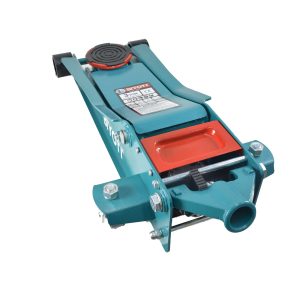
A hydraulic floor jack appears basic on the surface. You wheel it beneath the car, work the handle, elevate the saddle, and the vehicle ascends. Yet in an actual shop setting, secure raising hinges on various minor inspections: ground state, raising spot, load limit, wheel blocks, support stands, fluid state, and the ease of the release valve’s function. This hydraulic floor jack safety guide outlines key knowledge for mechanics, shop managers, tire crews, and committed car owners prior to raising a car, SUV, truck, or small van. It further presents the BYT-J4T Hydraulic Floor Jack, a 4 ton hydraulic floor jack equipped with a dual pump mechanism, robust steel frame, strengthened base, broad saddle, easy wheels, and several safety layers for expert raising tasks. Why Does Floor Jack Safety Matter Before Every Lift? A floor jack functions as a raising tool, not a lasting prop. This stands as the primary guideline. After the vehicle rises, the weight must rest on suitable jack stands before persons labor under or beside the frame. Numerous incidents arise not from the jack’s inability to raise, but due to the vehicle shifting, the earth settling, an improper raising spot, or the user depending on the jack

Read More
How Much Torque Do You Need in an Impact Wrench

How Much Torque Do You Need in an Impact Wrench?

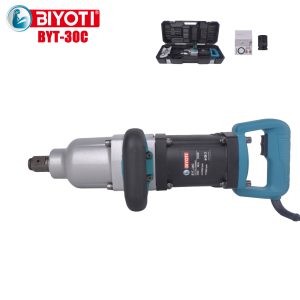
Picking the correct impact wrench torque goes beyond just grabbing the tool with the largest figure on the tag. For tasks like tire changes, truck wheel service, rusted bolts, machinery repair, and construction fastening, the main issue boils down to this: how much torque suffices for the task without harming the bolt, nut, wheel stud, or thread? This is where a powerful torque impact wrench like the BYT-30C Impact Wrench proves handy. It features a 1050W pure copper motor, a 400–1200N·M torque range, and 1400–1500 r/min no-load speed. The tool suits workshops, vehicle repair, equipment maintenance, and tough fastening jobs where weaker tools often fall short. What Does Impact Wrench Torque Really Mean? Impact wrench torque refers to the twisting force that loosens or tightens a fastener. It appears in units like N·M or ft-lb. In actual tasks, two torque values stand out: fastening torque and breakaway torque. Fastening torque means the force applied when tightening a nut or bolt. Breakaway torque is the force required to loosen a stuck, over-tightened, corroded, or dirty fastener. A wheel nut might only require moderate final torque. However, removing it after months of road salt, heat, and dust demands far more force. Working Torque vs

Read More
Why Table Saw Kickback Happens and How to Cut Safer

Why Table Saw Kickback Happens and How to Cut Safer

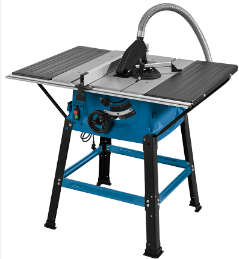
A table saw changes rough boards, plywood sheets, MDF panels, and hardwood stock into exact pieces fast. This is why it shows up in furniture shops, fix-up crews, small work areas, and keen home garages. But the same tool can also cause one of the quickest woodwork dangers: table saw kickback. Kickback means more than a board sliding back. It occurs when the wood gets grabbed by the blade. The piece lifts, twists, or flies toward the user. Often, it stems from a tiny fence slip, a bent board, a lost push stick, or a worn-out user hurrying the final slice. The danger hides well. The saw might sound fine until the wood shifts. This guide covers what leads to table saw kickback. It points out overlooked table saw dangers users miss. And it shows how to form better cutting ways with a solid table saw like the BYT-10A Table Saw. What Causes Table Saw Kickback? Table saw kickback often begins when the wood stops moving in a straight, guided line through the blade. The back teeth of the turning blade point toward the user. If the piece hits that back spot, sticks between the blade and rip fence, or turns

Read More
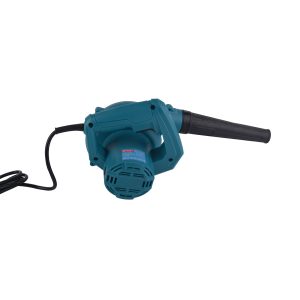
Commercial Uses for a High-Power Electric Blower

Commercial Uses for a High-Power Electric Blower

A busy car wash, a dusty woodworking shop, a repair bay, and a farm storage shed do not look alike. Yet they often share one small problem: loose dust, water drops, leaves, chips, and grit keep slowing the work down. Wiping by hand takes time. Compressed air is not always close by. A broom misses corners. This is where a portable electric blower becomes a practical tool for daily commercial cleaning. For business users, the right blower is not only about strong wind. It needs stable air output, a comfortable grip, reliable heat control, and a body that can handle routine use. The BYT-EB01/EB01C Blower is built around a 650W motor, 13,000 r/min no-load speed, and 2.5m³/min blowing rate, making it suitable for car wash drying support, farm equipment cleanup, workshop dust removal, construction site cleaning, and general equipment maintenance. Why Commercial Sites Need More Than a Household Blower? Commercial cleaning is different from home cleanup. A tool may run many times per day, move between dirty spaces, and handle dust, light debris, sawdust, leaves, or water left after washing. That places more stress on the motor, bearings, impeller, air duct, and outer housing. A small shop may need a blower

Read More
Search

categories

services
leave your message