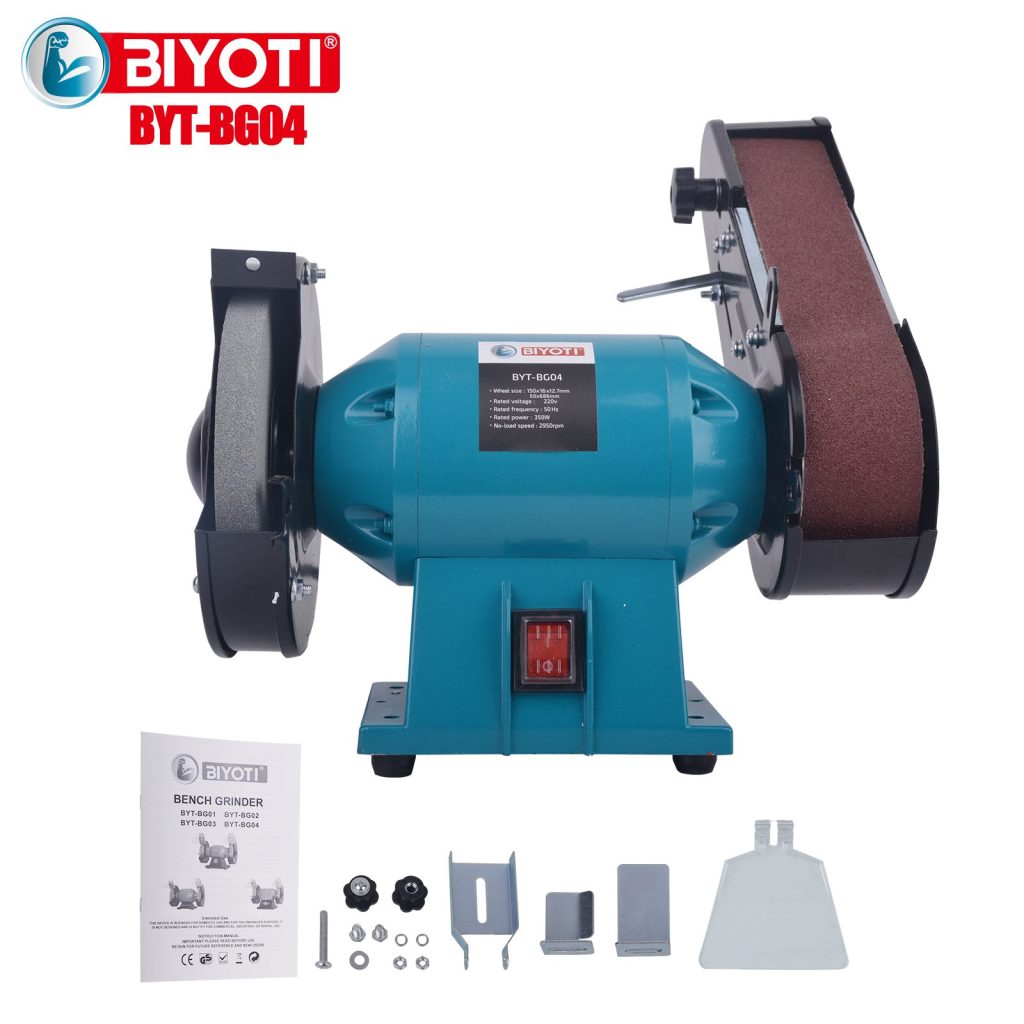
A simple setup for a bench grinder includes a motor, a wheel, a work rest and a base that is fixed in place. What one may see as a simple unit for cutting metal can in fact perform many other functions when using the right grinder. The bench grinder is able to sharpen worn tool edges, remove rust from work parts, file smooth cut ends, cut and shape smaller work pieces, prepare work surfaces prior to assembly, and even perform typical tool maintenance.
Bench grinders for workshop sharpening are compared by potential buyers not only for their use, but also with regard to the actual space required in the workshop. A machine that can be used for daily sharpening, rough grinding, fine sanding as well as for polishing is needed. Such a machine is the BYT-BG04 BENCH GRINDER, a compact, 2-position bench grinder.
What Is the Main Purpose of a Bench Grinder?
The bench grinder is a tool used to remove material in a controlled manner. It is a high-speed abrasive surface which can be used to cut, grind, to clean or to even out a workpiece surface. In small workshops, repair benches, in garages and also in DIY workshops the bench grinder is often the first tool to be picked up, because many tools have blades. These blades can become dull very quickly. Also many metal parts have edges which are very rough. In such cases it is very easy to even out the surface with a bench grinder.
A bench grinder is commonly used for:
· Sharpening knives, chisels, drill bits, and cutting tools
· Removing rust from steel or cast iron parts
· Cleaning welding marks and burrs
· Smoothing sharp metal edges after cutting
· Shaping small metal, wood, plastic, or acrylic parts
· Preparing a surface before painting, fitting, or polishing
The main advantage of using a file for edging is speed but then again there is sandpaper which is better for polishing but wears very quickly. Using a bench grinder has the advantage of being able to give a fixed, working length and also means that you have both hands free to control the workpiece.
The BYT-BG04 BENCH GRINDER is designed for routine tool maintenance and surface work. This model comes equipped with a 350W motor, 220V~50Hz single-phase power, 2950rpm no-load speed. As a bench grinder, it is mounted on a workbench for more stable grinding than with a hand held grinder.
How Do Bench Grinder Functions Work in Real Tasks?
While Bench Grinders are generally known for grinding only, there are many functions in addition to that. The single wheel, the type of abrasive, the amount of pressure against the work, and even the method of work movement all change the function of that wheel. A coarse abrasive is meant to remove material quickly. A finer abrasive is meant to produce a finer surface finish. A belt station is also available for grinders and is best for following curves and other irregular surfaces where a hard wheel would only produce scratches.
Common bench grinder functions by task
| Function | Typical workpiece | Practical result |
| Sharpening | Knives, drill bits, chisels | Restores cutting edge |
| Rough grinding | Steel parts, hardware | Removes extra material |
| Rust removal | Iron fittings, bolts, brackets | Cleans oxidized surface |
| Deburring | Cut metal edges | Removes sharp burrs |
| Surface sanding | Wood, plastic, acrylic, metal | Smooths visible marks |
| Light polishing | Small parts with fine abrasive | Improves surface finish |
After cutting a steel bracket the edge will have a sharp burr, which can be removed in seconds using a bench grinder. Drill bits can become dull during prolonged use. However, with a bit of patience, they can be sharpened back to their original cutting point. Small cast iron parts that have developed surface rust can be cleaned using the abrasive wheel and then repainted.
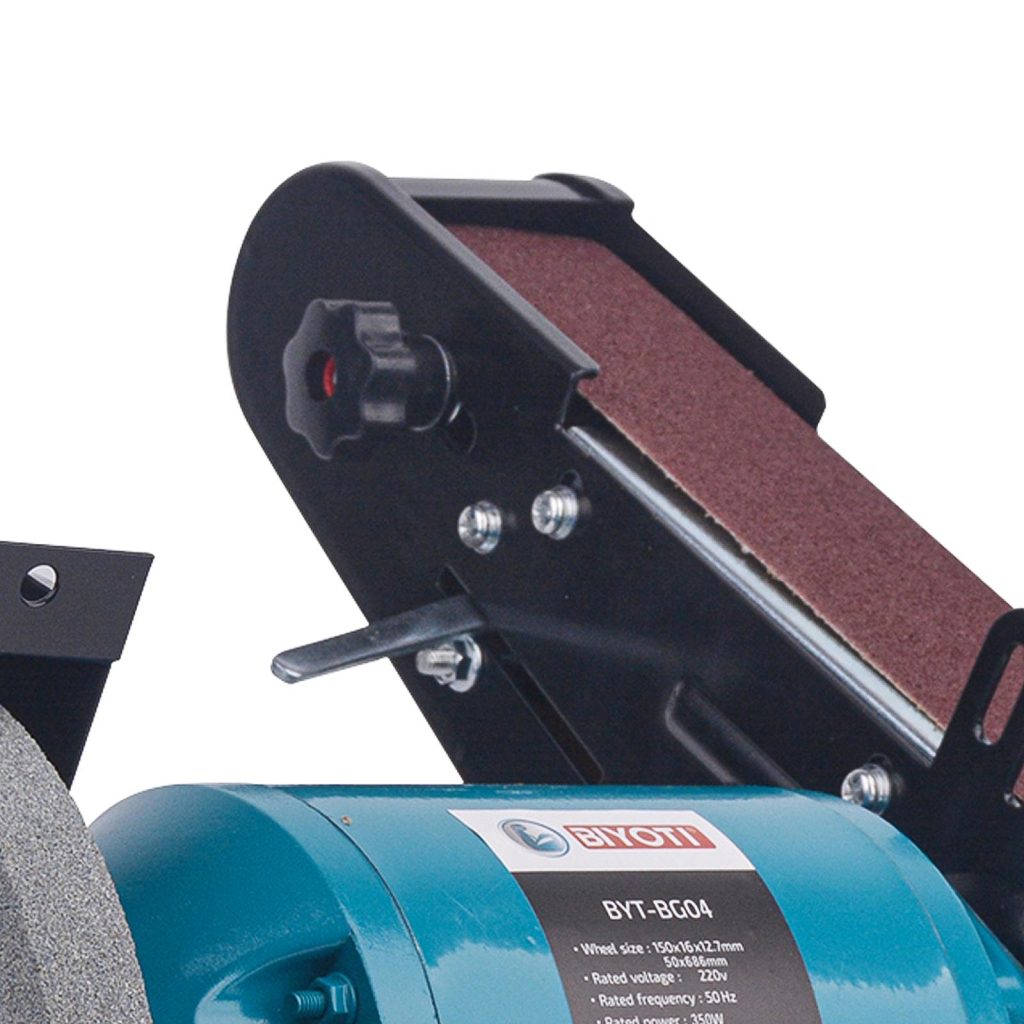
BYT-BG04 BENCH GRINDER is designed as a combo bench grinder and belt sander. Left side wheel is great for coarse grinding, sharpening, cutting and removing rust. Right side sanding belt is perfect for curved surface work, fine sanding and polishing. A two station machine in a compact package.
What Is a Bench Grinder Used for in Sharpening?
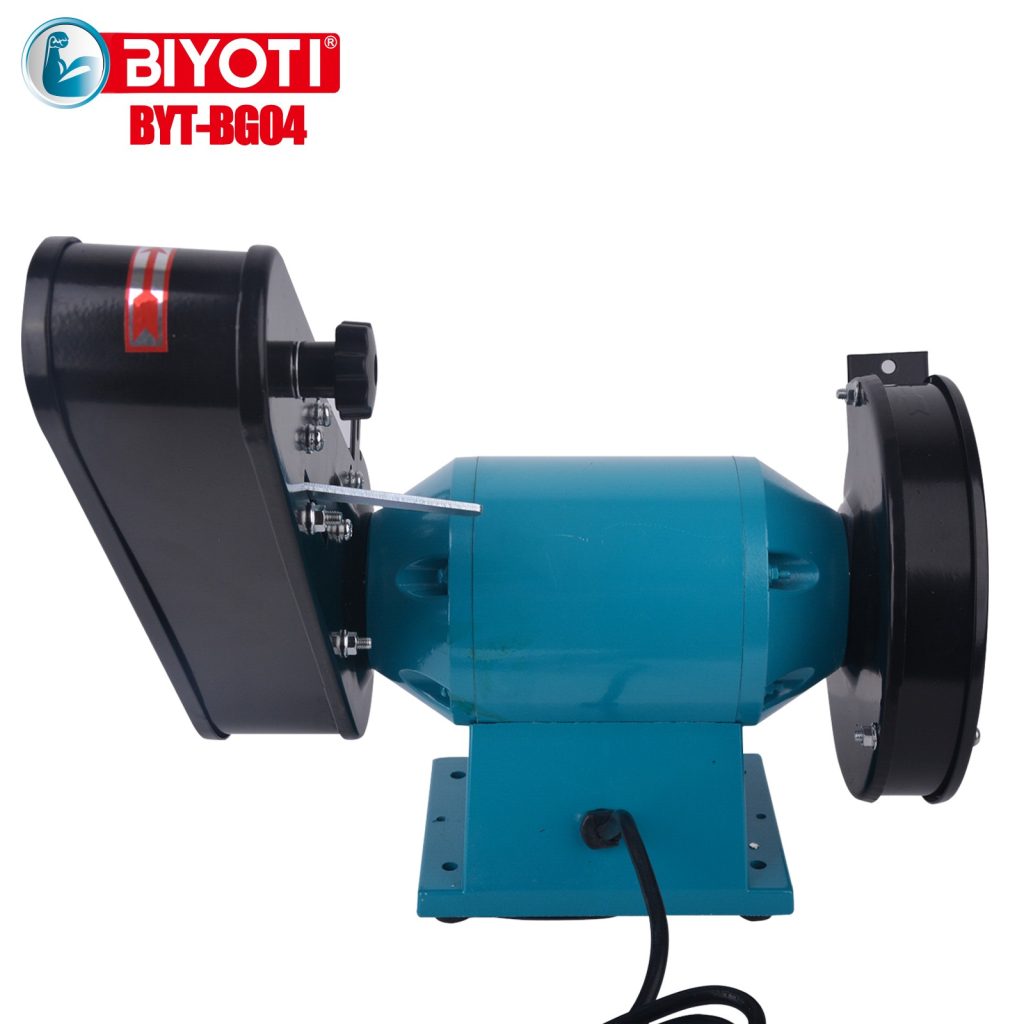
One of the most searched bench grinder uses is sharpening. Many cutting tools suffer from losing their edge due to heat, impact, excessive friction, or from wear against hard materials. A bench grinder is used for sharpening tools by re profiling the bevel or cutting edge, removing worn metal in the process.
When sharpening knives, it’s important to maintain a constant angle. For most kitchen knives, this is around 15-20 degrees. The blade should sit lightly on the work surface of the sharpening wheel and then glide across the abrasive surface in a smooth even motion. Too much pressure can cause the edge of the knife to overheat and eventually weaken the steel. When sharpening drill bits, the point angle must be sufficient to meet the cutting requirement. Also, both sides of the bit must be ground evenly.
Better sharpening habits
· Keep both hands steady on the tool or workpiece.
· Do not push the blade hard into the wheel.
· Move the edge evenly to avoid overheating one spot.
· Cool metal parts in water when they become hot.
· Use only the wheel’s round face, not the side surface.
Note: Sharpening is not about how hard you press, but about the angle, the amount of time the edge is in contact with the stone, and how you control the heat. If the edge starts to turn blue it can lose its hardness, so use short strokes of grinding and cool the edge as you go.
BYT-BG04 BENCH GRINDER is designed for sharpening and supports this task by running at a fixed speed of 2950rpm. The 150×16×12.7mm grinding wheel is optimally suited for sharpening knives, sharpening drill bits, small cutting tools and workshop blades. In contrast to sanding, sharpening with a fixed grinding point is more exact.
Why Is the Belt Station Useful for Fine Sanding and Curves?
A standard grinding wheel is the best tool for grinding hard materials. However, grinding with a curved or irregular shape is not best done with a grinding wheel. A sanding belt has a wider contact path and can leave a better finish. So, a bench grinder with a belt sander function is ideal for parts that require more than just rough grinding.
The belt station is useful for:
· Curved metal edges
· Wood craft parts
· Plastic and acrylic edges
· Small hardware finishing
· Weld mark smoothing
· Surface leveling after wheel grinding
Belt grits can produce vastly different results. For removing deep scratches, for roughing out, for removing large burrs, for rust removal and for weld clean up a 40-80 grit belt is ideal. For leveling, for removing deep wheel marks, a 120-240 grit belt is best. For fine sanding and polishing with a polishing paste, use a 320 grit or finer belt.
| Belt grit | Best use | Surface result |
| 40–80 grit | Rough sanding, rust, weld marks | Fast removal |
| 120–240 grit | Surface leveling | Cleaner finish |
| 320+ grit | Fine sanding, polishing prep | Smooth surface |
Light pressure is required when cutting wood and plastic. Excessive friction can cause burn marks on wood and melt the plastic edges. The same heat rules apply to metal. Use short contacts and maintain steady movement. Allow work to cool as required.
The BYT-BG04 BENCH GRINDER is equipped with a 50×686mm sanding belt to function as a second working station for fine grinding, sanding of curved surfaces and polishing. This means that users can complete additional work steps on one machine, instead of needing to switch to another tool.
How Can a Bench Grinder Improve Workshop Efficiency?
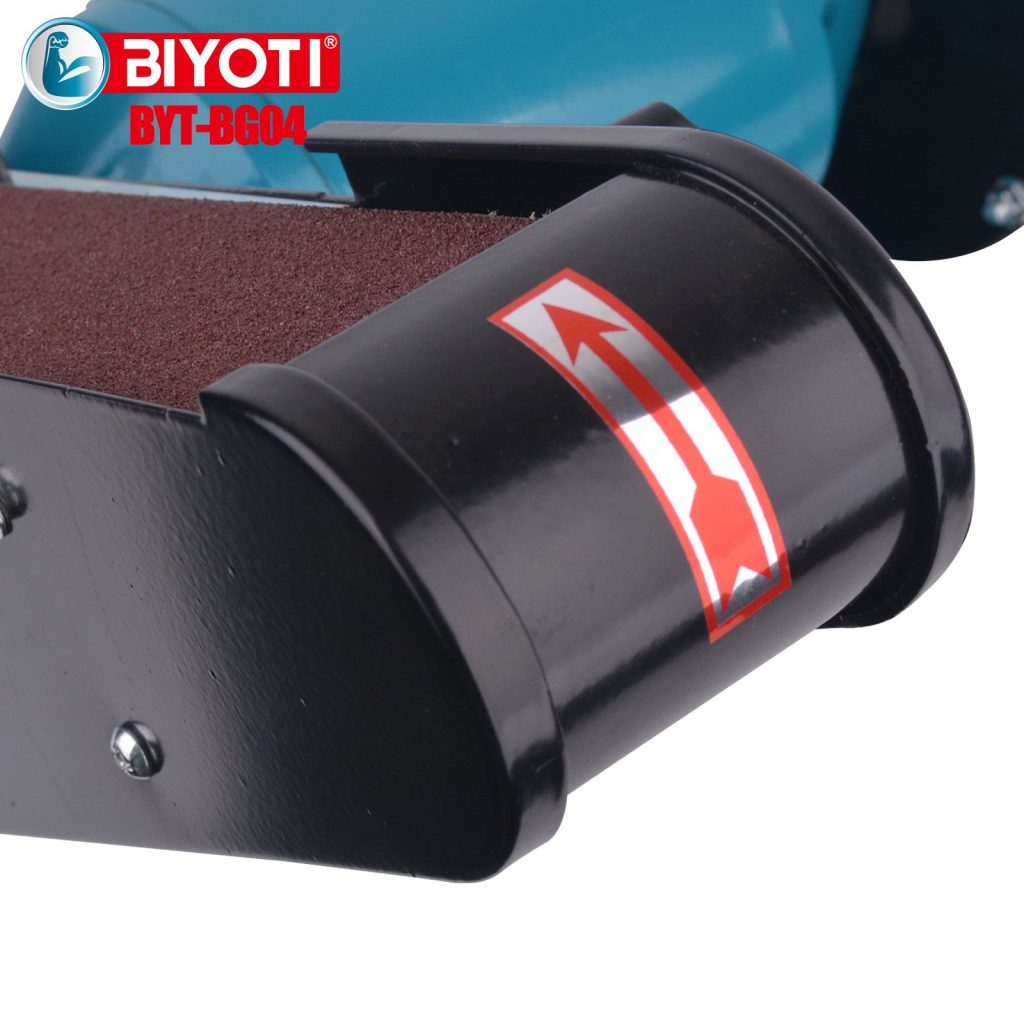
Bench grinders save time because they are always at the ready. In a repair shop, a worker could use his or her bench grinder for many small correction work tasks throughout the day. For example, sharpening a dull chisel, removing a rough end from a bolt, lubricating a rusty hinge, or dulling a too sharp cut edge. All of these tasks can be completed very quickly without having to go get a larger piece of equipment.
Practical workshop examples
When cutting steel strips in a small metalwork area, cut ends can be left with burrs which can cause damage to hands and also cause problems when trying to assemble. Use a bench grinder to remove these burrs before trying to fit.
In a woodworking shop, the edges of chisels and carving tools require frequent sharpening. The primary edge is sharpened on a bench grinder and then honed to a micro-inch finish by hand.
Rust removal from old bolts, brackets, etc. made from iron is a common task in home repair. Using a grinder to remove the rust first makes the job easier and saves a lot of time.
In craft production items made of acrylic or plastic can require edge trimming after cutting. The belt station can then be used to smooth the edge, using less aggressive contact than a grinding wheel.
BYT-BG04 BENCH GRINDER is mainly for small workshops, home garages, repair benches, hardware stores DIY, hand crafts processing. As it is 220V household version, no special industrial power wiring is required. It can be put on common working places.
What Safety Rules Matter Most When Using a Bench Grinder?
Bench grinder safety is important because the abrasive surface on a bench grinder is moving at a high speed and can create problems with sparks, dust, broken pieces of the abrasive, and more. With these kind of potential problems, it is very important to take the proper safety measures to complete any grinding task, even for a short amount of time. The safety habits to properly use a bench grinder should become second nature.
Pre-operational checks prior to use of the bench sander are: check wheel, belt, guards, work rest, base, switch and power cable. Check wheel for cracks or missing parts. Check belt for signs of wear, such as being torn, coming loose or being offset. Check work rest gap, which should be no more than 3mm. Check that machine is stable, not to rock or vibrate while standing on level ground.
Basic safety checklist
· Wear safety glasses or a face shield.
· Use a dust mask when grinding metal, wood, or plastic.
· Do not wear gloves, scarves, or loose sleeves near rotating parts.
· Tie back long hair.
· Clamp very small workpieces instead of holding them by hand.
· Let the machine run unloaded for 30 seconds to 1 minute before work.
· Stop immediately if there is abnormal noise, vibration, smell, or belt tracking.
Always keep guard open, never touch surface of wheel or belt while machine is in operation. Never grind flammable or explosive materials. Always avoid operating machine under heavy load for long periods of time. After approximately 30 minutes of continuous operation, allow motor to cool before continuing to use.
The BYT-BG04 BENCH GRINDER has been designed with safer bench work in mind. The guard system, robust base for the bench and dual-station format all lend themselves to improved control of the workpiece. However, personal protection and correct use of the grinder is paramount.
How Should Users Choose Wheels and Belts for Better Results?
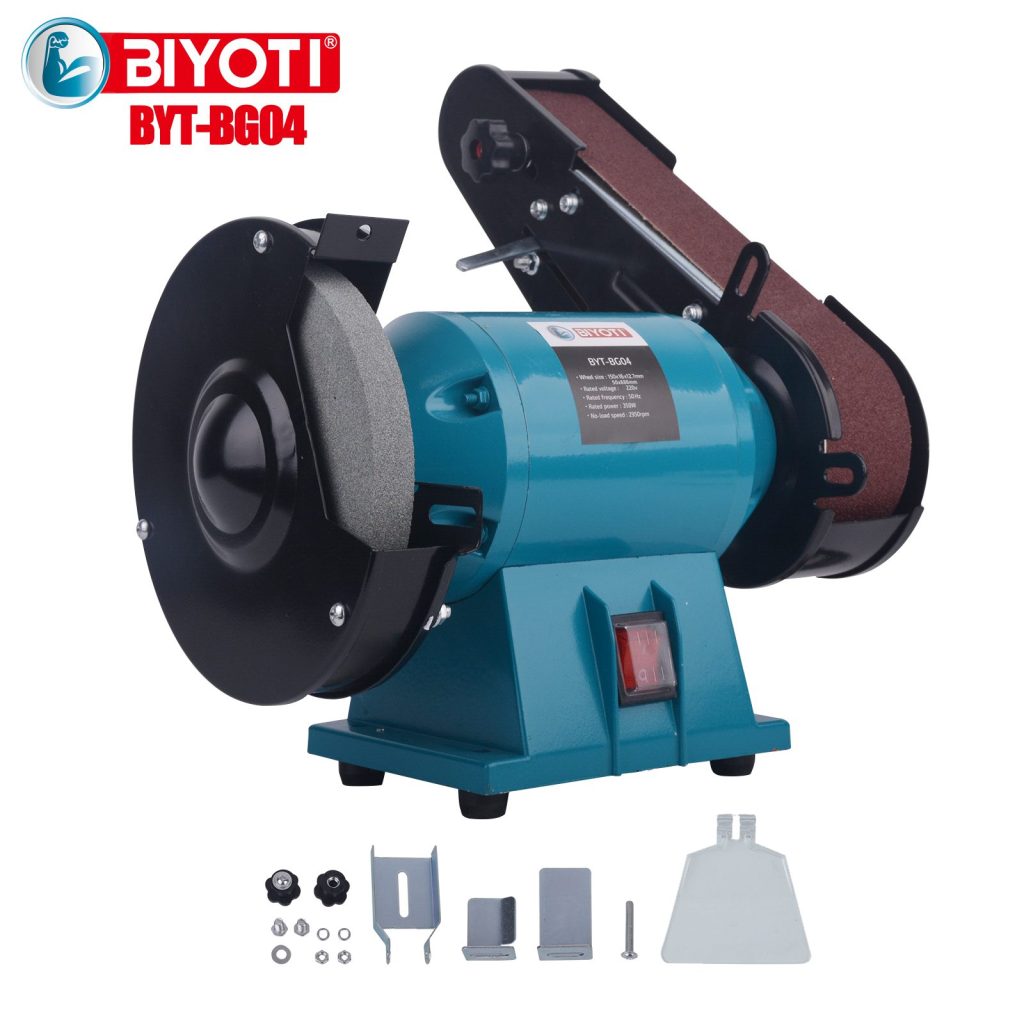
The consumables are what give the final result. A good quality bench grinder can produce poor results if used with the wrong wheel or belt. For metal grinding, Aluminum oxide wheels are a common choice as they are suitable for grinding steel and cast iron. For the BYT-BG04 BENCH GRINDER the recommended matched wheel size is 150×16×12.7mm.
36-60 grit is good for rough grinding, removes a lot of material, good for removing rust, weld slag, or just for a heavy cleaning. 80-120 grit is good for sharpening and general tool correction, has a good surface finish and is able to remove material fast enough for most uses.
Also with sanding belts, the material is important. Aluminum oxide sanding belts are used for steel and cast iron. Silicon carbide sanding belts are used for stainless steel, non-ferrous metals as well as hard surfaces. Zirconia alumina sanding belts are extremely wear resistant and are often used for strong metal as well as weld grinding.
When replacing a wheel or belt, always start by disconnecting power. After you have changed the wheel or belt, first run the machine without a load. Check for any vibration, that the belt is tracking correctly and that the machine is rotating evenly and stably before coming near the workpiece.
BYT-BG04 BENCH GRINDER. This model supports wheel and belt type consumables, therefore can be used by all users who process materials of mixed type. By choosing the proper grit of consumable, the same machine can be used for rough cleaning and for sharpening as well as for final surface finishing.
Yongkang Jiakai Industry and Trade Co., Ltd. as a Supplier
Yongkang Jiakai Industry and Trade Co., Ltd. from Yongkang of Zhejiang province which is one of the well-known cities of China for its huge hardware and tool industry. Yongkang Jiakai supplies a wide range of power tools including electric drills, angle grinders, laser levels, hand saws, welding machines and surface grinders. Their products are exported to Europe, USA and other countries in Southeast Asia, thus they can offer a variety of power tools for professional use as well as for distribution in hardware stores.
Yongkang Jiakai Industry and Trade Co., Ltd. – supplier of BYT-BG04 BENCH GRINDER. Practical value for importers, wholesalers, workshops and retail tool channels of small sized grinders. For the buyer there is more value in a supplier than just a product, also the scope of products that the supplier can deliver, the experience of the supplier in manufacturing, export experience of supplier and tool selection support.
Conclusion
One of the most useful of the fixed tools in any workshop is the bench grinder. Such a machine is of value not because it can do a few things, but because it can do several things. First, there are the edges that become dull from use. There are the rusty parts and surfaces that require to be smoothed. There are the jobs where better finish is required than that produced by sawing or by other methods of cutting. There are the inevitable burrs that occur on cut metal. There are also occasions when a small amount of material needs to be removed from a surface to achieve an even finish.
BYT-BG04 BENCH GRINDER is a grinding and sanding machine all in one unit. The BYT-BG04 BENCH GRINDER is a practical bench grinder with belt sander function for daily workshop maintenance and small-scale material finishing. The BYT-BG04 BENCH GRINDER has 350W motor, 2950rpm, 150×16×12.7mm grinding wheel and 50×686mm sanding belt. It can be used for sharpening, rust removal, deburring, curved surface sanding, fine grinding and light polishing.
FAQs
What are the main bench grinder functions?
Functions of a bench grinder: sharpening, rough grinding, rust removal, deburring, shaping, surface sanding and polishing. A dual-station grinder also can have a wheel side and a belt sanding side.
What is a bench grinder used for in a home workshop?
A typical use of a bench grinder in a home workshop is for sharpening knives and tools. Also, use it to clean rusted hardware, to deburr metal to a smooth edge, to correct small parts that are out of shape, and to smooth a surface prior to finishing.
Can the BYT-BG04 BENCH GRINDER be used for wood and plastic?
Yes. BYT-BG04 BENCH GRINDER can be used for wood, plastic, acrylic, steel and cast iron. When sanding wood or plastic always use light pressure and never hold workpiece in one place for to long time.
Is a bench grinder with belt sander better than a standard grinder?
A bench grinder with belt sander is a more versatile tool for mixed tasks. The wheel is best for sharpening, removing rust and coarse grinding. The belt is best for curved surfaces, finer sanding and polishing.
What safety checks are needed before using a bench grinder?
Check wheel for cracks. Check belt for damage or misalignment. Ensure work rest gap is maintained at 3mm or less. Wear eye and dust protection. Allow machine to run unloaded for 30 seconds to 1 minute before grinding.